Let's talk
Let us know which of the Shipnet Suite of software tools interests you, and we'll get back to you to discuss how we can help.
Oct 9, 2026
My background is in marketing and advertising, including within the hospitality industry, where so much of the work centres on what catches people’s attention, makes them feel welcome or encourages them to choose you.
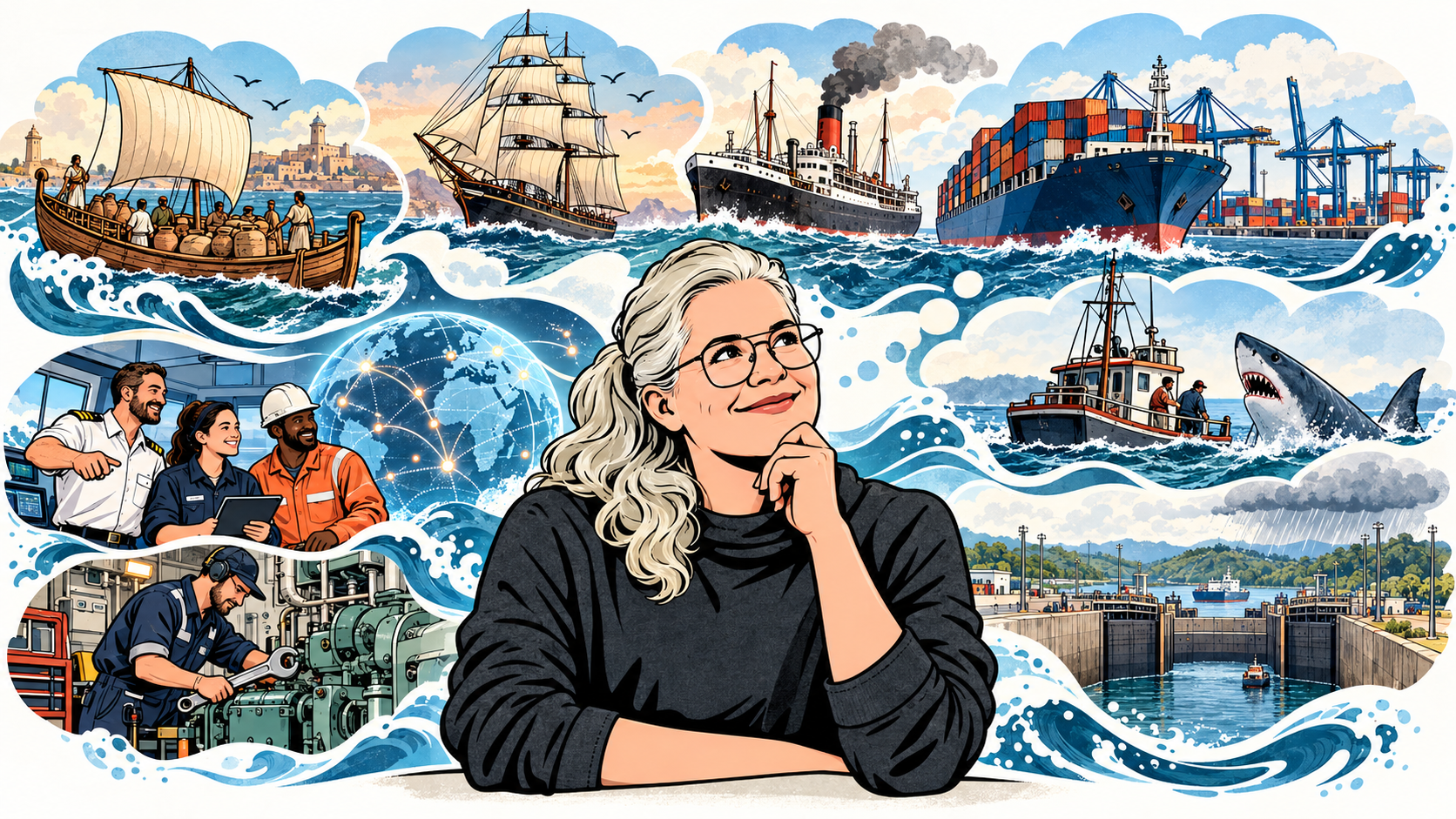
Joining Shipnet introduced me to a different set of everyday questions. What needs maintaining? Does the crew have what they need? How do we keep vessels safe and get cargo where it needs to be, on time?
The more I learn about the people and processes behind those questions, the more I realise how much there is still to understand. Including a few assumptions I brought with me…
The IMO’s estimate put shipping at roughly 3% of global human-caused CO₂ emissions. That’s significant, and reducing it matters. But the picture is more nuanced than the “biggest climate culprit” image I’d absorbed.
Much originates on land, reaching the sea through rivers and mismanaged waste. Discharging plastics from ships has been prohibited under MARPOL Annex V since 1988. A ban doesn’t mean pollution disappears, but it challenged my assumptions about its sources.
Piracy remains a serious threat in some regions. But it isn’t interchangeable with the geopolitical attacks on merchant shipping we’ve seen in the Red Sea. Different threats require different responses.
Then there are the less dramatic things that reveal how interconnected shipping really is
Its country of registration, owners and crew can all come from different places. One vessel can represent a remarkably international operation.
A shipping delay isn’t necessarily a slow ship.
Port congestion, cargo handling, onward transport and clearance can all affect the journey. Getting goods delivered depends on far more than the voyage itself.
The Panama Canal restrictions in 2023 were driven by drought and low reservoir levels. I hadn’t appreciated how directly a freshwater shortage could affect a global trade route.
Every loss can cause harm. But the World Shipping Council estimated 1,478 containers lost in 2025 out of approximately 280 million transported - a very small proportion of an enormous operation.
Some changes are smaller. Shipping terminology slips into everyday conversation. A customer’s name on a container suddenly catches your eye.
You start feeling part of something you once knew very little about.
What I’ve gained most is respect for the people onboard and ashore whose expertise keeps this industry moving. They help keep the world fed, supplied, and in business, often without much recognition from the rest of us.
It’s a privilege to play a small part in supporting their work.
What assumption about shipping changed when you joined the industry?

Jenny Duffy
Marketing Director