Let's talk
Let us know which of the Shipnet Suite of software tools interests you, and we'll get back to you to discuss how we can help.
Oct 26, 2026
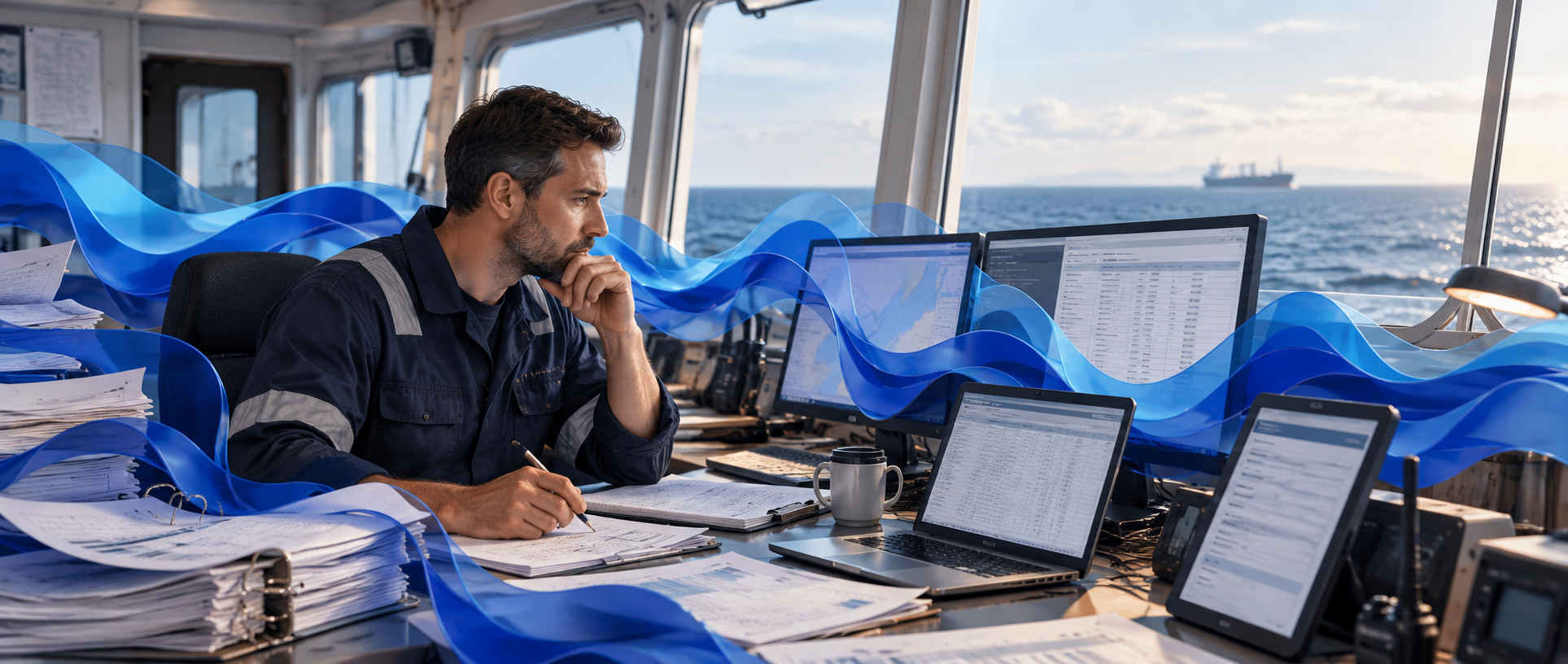
Maritime digitalisation has replaced filing cabinets, printed forms and handwritten logs with software, spreadsheets and electronic records. Yet speak to people working at sea and many will tell you that the paperwork has not disappeared. It has multiplied across screens
One career mariner recently described paperwork as the most challenging part of the job. During an ordinary working day, attention moves between ECDIS, radar, voyage-planning software, ballast-water logs, cargo-control screens, spreadsheets and the planned maintenance system.
That is only one person’s experience, but the frustration will be familiar across the industry. Ships have more technology than ever, yet crews and shore teams can still spend a substantial part of their working day entering, checking and transferring information.
The problem is not that shipping has failed to become digital. It is that digitising a form does not necessarily improve the process around it.
Converting a paper form into an electronic one can improve legibility, storage and access. It can create an audit trail and make information available beyond the vessel.
Those are real benefits, but the amount of work only falls if the information can continue through the process without being repeatedly re-entered or reconstructed.
Consider a maintenance task completed on board. The engineer records the work in the planned maintenance system, updates the equipment history and notes the spare part used. If the inventory system does not update with it, somebody must record the stock movement separately. If shore management cannot see the latest information, the vessel may be asked to confirm it by email. If finance needs a different description or reference, another person may need to interpret the transaction later.
Everything is digital. Much of the process remains manual.
See how Shipnet connects maintenance and technical operations
Give vessel and shore teams a shared view of work orders, defects, spares and maintenance history.
Specialist maritime systems are often good at the function they were designed to perform. The additional work appears when an operational process crosses the boundaries between them.
A maintenance requirement can affect inventory, procurement, vessel scheduling and budgets. An inspection finding may involve safety records, documents, corrective work and purchasing. A voyage decision can change fuel requirements, carbon exposure and financial results.
When each department sees only its own part, people must carry the information between them. They copy it into spreadsheets, add explanations to emails and check one record against another before acting.
This administrative work can become so familiar that it is no longer recognised as a system problem. It is simply accepted as part of the job.
Connect maintenance demand with procurement
See how Shipnet links technical requirements, purchasing, logistics, budgets and finance in one operational workflow.
The issue is not only the time spent entering information. Every handoff creates another opportunity for records to drift apart.
The vessel may record that a spare has been consumed while the shore inventory still shows it as available. Procurement may be working from a specification copied from an older email. Finance may see the invoice without the operational reason the expenditure was approved.
Each record can be correct within its own narrow context while the wider operational picture remains incomplete.
A dashboard can bring figures from different sources onto one screen, but presentation alone does not make them consistent. Useful visibility begins with the relationships between the records beneath it.
Shipping companies are often asked how many processes they have digitised. A more revealing question is what their people no longer need to do.
Do crews enter information once, or several times?
Can shore teams see the current vessel position without requesting another spreadsheet?
Does a requisition retain its connection to the maintenance requirement that created it?
Can someone covering a colleague’s leave understand the open work without receiving a personal explanation of every email chain?
These questions measure whether technology has reduced the work rather than changed its appearance.
People working on vessels already balance maintenance, navigation, cargo operations, safety, compliance and life away from home. Shore teams are supporting multiple vessels while managing suppliers, budgets and operational changes.
A digital system should not add another layer of administration simply because collecting more information has become possible.
Once data has been entered and approved, it should be available wherever it is legitimately needed. Changes should follow the workflow, and exceptions should be visible without people having to compare every record manually.
That does not mean every department must use exactly the same screen. It means they should be working from connected information rather than maintaining separate versions of the same situation.
Maritime digitalisation has delivered enormous improvements, but the presence of software is not proof that a process has improved.
If crews still reproduce information for shore, departments reconcile their systems in spreadsheets and routine decisions begin with checking several records, the organisation has gone paperless without removing the paperwork.
At Shipnet, we believe connected maritime software should be judged by the work it gives back to people. Maintenance, procurement, safety, documentation and finance have different responsibilities, but the information should remain connected as the operation moves between them.
The industry does not need another promise that paperwork will disappear. A more useful ambition is to ensure information already recorded does not keep becoming somebody else’s administrative task.
Has digitalisation reduced the workload in your organisation - or moved it onto more screens?
Where is administration getting in the way of your operation?
Show us how your teams work today. We’ll demonstrate how Shipnet can connect the information, processes and people involved - using a scenario relevant to your fleet.
Request a personalised demonstration →

Danny James
Marketing Manager